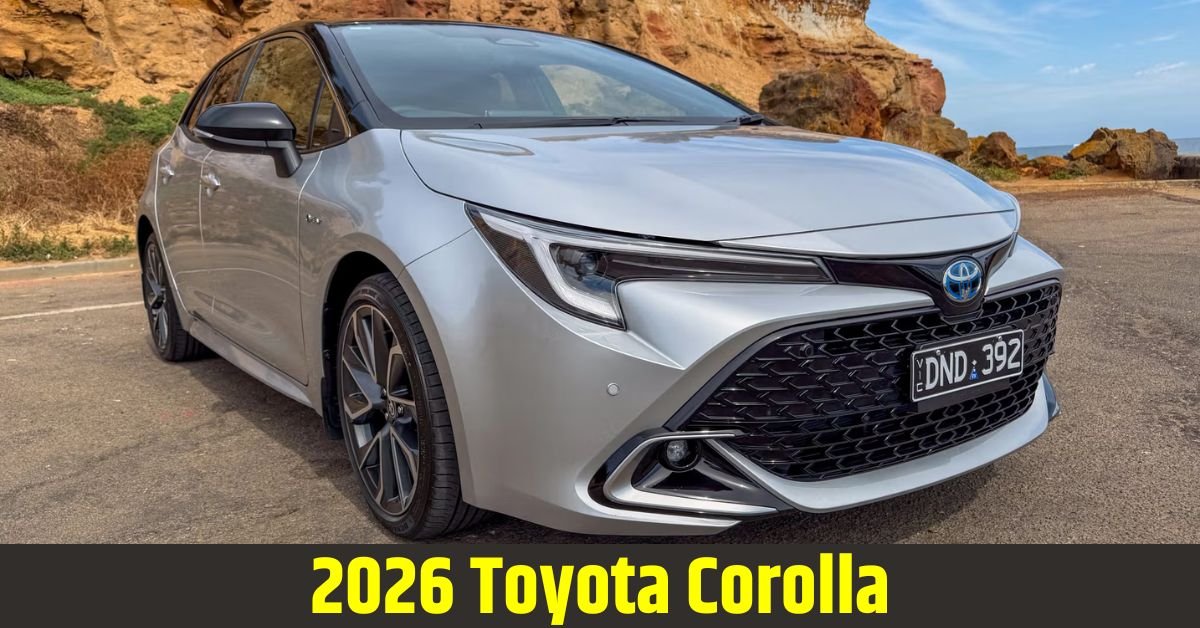

The 2026 Toyota Corolla is the car people buy when they want something that starts every morning, sips fuel like it’s on a budget, fits into tight parking spots, and doesn’t turn routine ownership into a monthly drama. The Corolla’s formula is familiar, maybe even a little predictable, but that’s exactly why it keeps working.
2026 Toyota Corolla
For decades, the Toyota Corolla has been the default answer for shoppers who want safe, affordable, reliable transportation. It isn’t flashy. It doesn’t shout. It simply shows up, does the job, and keeps ownership costs under control.
For 2026, the Corolla continues in both sedan and hatchback body styles, giving buyers a little flexibility. The sedan is the better choice for people who regularly carry passengers, while the hatchback brings a sportier shape and more cargo flexibility.
The biggest appeal remains fuel economy. The standard gas model is already efficient, but the available hybrid sedan is the one to watch for buyers who want maximum miles per gallon. With ratings as high as 53 mpg city and 50 mpg combined, the hybrid Corolla is still one of the smartest commuter cars on the market.
What’s New for 2026?
The most noticeable update for 2026 is the arrival of the Corolla Hatchback FX Edition. Toyota gave the hatchback the same kind of FX treatment that appeared on the sedan previously, adding a racier look without turning the Corolla into a full-blown performance car.
The FX Edition gets a rear wing, white 18-inch wheels, and three available exterior colors: Ice Cap, Inferno, and Blue Crush Metallic. Inside, it features sport seats with suede inserts and orange contrast stitching on the seats and door panels.
Toyota is limiting the FX Edition hatchback to just 1,600 units, which gives it a bit of collector-lite appeal. Not rare like a supercar, obviously, but rare enough that Corolla fans may want to pay attention.
Elsewhere in the lineup, Toyota has added digital gauge displays as standard equipment. LE and SE trims get a 7.0-inch display, while XSE and XLE trims receive a larger 12.3-inch unit. Blind-spot monitoring and rear cross-traffic alert are now standard as well, which is a meaningful safety upgrade for everyday driving.
2026 Toyota Corolla Price and Trims
The 2026 Toyota Corolla starts at $24,320 and reaches $30,535 depending on trim, body style, and powertrain. That keeps it in the heart of the compact-car market, though higher trims can approach the price of some small crossovers.
| Trim | Starting Price |
|---|---|
| LE | $24,320 |
| SE | $25,775 |
| Hybrid LE | $26,170 |
| SE Hatchback | $26,760 |
| FX | $28,375 |
| Hybrid SE | $28,610 |
| XSE | $28,770 |
| XSE Hatchback | $30,035 |
| Hybrid XLE | $30,535 |
The SE sedan looks like the best pick for most buyers. It has a slightly sportier personality than the LE, thanks to its firmer suspension, and it comes with useful features such as LED headlights, 18-inch wheels, a leather-trimmed steering wheel, and an 8.0-inch touchscreen with Apple CarPlay and Android Auto.
The Hybrid LE is the smarter choice for buyers focused mainly on fuel savings. Meanwhile, the FX hatchback is more about style and exclusivity than outright speed.
Engine, Transmission and Performance
The standard Corolla uses a 2.0-liter four-cylinder engine making 169 horsepower. It sends power to the front wheels through a continuously variable automatic transmission.
That powertrain is not exciting, but it is perfectly fine for daily use. Around town, the Corolla feels calm and predictable. On the highway, it cruises comfortably enough. The problem comes when you ask for quick acceleration. Push it hard, and the engine gets noisy in that classic small-car CVT way. It moves, yes, but it doesn’t exactly enjoy being rushed.
The sedan also offers a hybrid powertrain. The hybrid is quieter and more efficient, but it is not quick. That’s not really the mission, though. This is a car built for long fuel range and low running costs, not stoplight bragging rights.
| Model | Powertrain | Character |
|---|---|---|
| Corolla gas sedan | 2.0-liter 4-cylinder | Simple, efficient, steady |
| Corolla hatchback | 2.0-liter 4-cylinder | Slightly more playful |
| Corolla hybrid sedan | Hybrid system | Very efficient, relaxed |
| Corolla FX hatchback | 2.0-liter 4-cylinder | Sportier look and sharper feel |
Ride quality is one of the Corolla’s stronger points. Both the sedan and hatchback handle bumps well, and body control is better than older Corolla generations. The SE and XSE trims feel firmer because of their sport-tuned suspension, while the FX hatchback adds a bit more personality in corners.
Still, buyers looking for genuine driving enjoyment may prefer the Honda Civic or Mazda 3. The Corolla is competent, but those rivals feel sharper and more engaging from behind the wheel.
0–60 MPH Performance
Nobody buys a Corolla for drag-strip drama, and the numbers prove it.
The all-wheel-drive hybrid model reaches 60 mph in 9.0 seconds, while the Corolla FX hatchback manages the run in 8.2 seconds. Those times are acceptable for a compact daily driver, but not quick.
| Model Tested | 0–60 MPH Time | Top Speed |
|---|---|---|
| Corolla Hybrid AWD | 9.0 seconds | 107 mph |
| Corolla FX Hatchback | 8.2 seconds | 111 mph |
The Corolla’s performance story is not about speed. It’s about easy driving, predictable handling, and low fuel use. In that role, it does exactly what it needs to do.
Fuel Economy and Real-World MPG
Fuel economy is where the Corolla really earns its paycheck. The nonhybrid model is rated as high as 32 mpg city, 41 mpg highway, and 35 mpg combined.
The hybrid is even better, with ratings as high as 53 mpg city, 46 mpg highway, and 50 mpg combined. For commuters dealing with high fuel prices, long drives, or city traffic, that can make a real difference.
| Version | City MPG | Highway MPG | Combined MPG |
|---|---|---|---|
| Nonhybrid Corolla | 32 | 41 | 35 |
| Corolla Hybrid | 53 | 46 | 50 |
In real-world highway testing, the all-wheel-drive hybrid returned 40 mpg, while a gas-only Corolla XSE sedan reached 41 mpg. Hatchback test results came in at 40 mpg and 36 mpg, depending on configuration.
That means even the less efficient Corolla versions remain impressively economical.
Interior, Comfort and Cargo
Inside, the 2026 Corolla keeps things clean and simple. The dashboard layout is straightforward, materials are soft-touch in key areas, and most controls are easy to understand without digging through menus. There’s nothing overly dramatic here, but that’s part of the charm.
Many models include passive entry and push-button start. Available upgrades include ambient interior lighting, dual-zone climate control, and heated front seats.
The sedan is the better choice for passengers. It offers noticeably more rear-seat legroom than the hatchback, making it a smarter pick for families, rideshare drivers, or anyone who regularly carries adults in the back seat.
Cargo space depends heavily on body style. The hatchback offers 18 cubic feet behind the rear seats, though its shape limits how much luggage can fit. Toyota offers an Enhanced Cargo Space option that removes the spare tire and replaces it with a tire-repair kit, expanding cargo volume to 23 cubic feet.
The sedan has a smaller 13-cubic-foot trunk, but its shape is more useful than the number suggests.
| Body Style | Cargo Space | Best For |
|---|---|---|
| Sedan | 13 cubic feet | Passengers and trunk practicality |
| Hatchback | 18 cubic feet | Flexible cargo use |
| Hatchback with Enhanced Cargo Space | 23 cubic feet | Maximum hatchback storage |
Interior storage is acceptable, though not class-leading. There’s a handy tray near the front of the center console and a useful bin under the armrest, but some rivals offer better cabin cubby space.
Infotainment and Connectivity
Every 2026 Corolla comes with an 8.0-inch touchscreen infotainment system. Apple CarPlay and Android Auto compatibility are standard, along with a subscription-based Wi-Fi hotspot.
A larger 10.5-inch touchscreen is available. Toyota also includes four USB-C ports, split between front and rear passengers, plus a 12-volt accessory outlet.
| Feature | Availability |
|---|---|
| 8.0-inch touchscreen | Standard |
| 10.5-inch touchscreen | Optional |
| Apple CarPlay and Android Auto | Standard |
| Wi-Fi hotspot | Subscription-based |
| USB-C ports | Four total |
| Wireless charging | Available |
| JBL audio system | Available |
The new standard digital gauge displays help the Corolla feel more modern. LE and SE trims get a 7.0-inch display, while XSE and XLE trims get the larger 12.3-inch version.
Safety and Driver Assistance
Safety remains one of the Corolla’s strongest selling points. Toyota equips the lineup with Toyota Safety Sense 3.0, which includes a wide range of standard driver-assistance features.
Standard features include forward-collision warning, automated emergency braking, lane-departure warning, lane-keeping assist, adaptive cruise control, automatic high beams, and road sign assist.
For 2026, blind-spot monitoring and rear cross-traffic alert are also standard, making the Corolla even more appealing for daily commuting and urban driving.
| Safety Feature | Availability |
|---|---|
| Forward-collision warning | Standard |
| Automated emergency braking | Standard |
| Lane-departure warning | Standard |
| Lane-keeping assist | Standard |
| Adaptive cruise control | Standard |
| Blind-spot monitoring | Standard |
| Rear cross-traffic alert | Standard |
| Road sign assist | Standard |
That level of standard safety equipment gives the Corolla a strong value argument, especially for younger drivers, commuters, and families shopping on a budget.
Warranty and Maintenance Coverage
Toyota gives the Corolla competitive warranty coverage, though some rivals offer longer powertrain protection. Hyundai and Kia, for example, stretch powertrain coverage to 10 years or 100,000 miles.
Still, Toyota includes complimentary scheduled maintenance for two years or 25,000 miles, which adds real-world value.
| Coverage | Term |
|---|---|
| Limited warranty | 3 years / 36,000 miles |
| Powertrain warranty | 5 years / 60,000 miles |
| Hybrid components | 10 years / 150,000 miles |
| Complimentary maintenance | 2 years / 25,000 miles |
The hybrid component coverage is especially important for buyers planning to keep the car long-term.
Is the 2026 Toyota Corolla Worth Buying?
The 2026 Toyota Corolla remains one of the safest bets in the compact-car market. It is affordable, efficient, easy to drive, and backed by Toyota’s reputation for long-term dependability.
It is not the most exciting car in the class. The Honda Civic is more refined and engaging. The Mazda 3 feels more premium and more enjoyable on a twisty road. But the Corolla counters with excellent fuel economy, strong safety equipment, broad trim availability, and low-stress ownership.
For most shoppers, the SE sedan is the best all-around pick. For fuel-savers, the Hybrid LE is hard to ignore. And for buyers who want something a little different, the limited-run FX hatchback brings some welcome visual attitude.
The Corolla may not make your heart race, but it probably won’t make your wallet cry either. And for a lot of buyers, that’s the whole point.
FAQs
How much does the 2026 Toyota Corolla cost?
The 2026 Toyota Corolla starts at $24,320 for the LE trim and goes up to $30,535 for the Hybrid XLE.
Is the 2026 Toyota Corolla available as a hybrid?
Yes, the Corolla sedan offers hybrid models, including the Hybrid LE, Hybrid SE, and Hybrid XLE.
What is the most fuel-efficient 2026 Toyota Corolla?
The hybrid version is the most efficient, rated as high as 53 mpg city, 46 mpg highway, and 50 mpg combined.
What is new on the 2026 Toyota Corolla?
The Corolla Hatchback gets a limited FX Edition, digital gauge displays are now standard, and blind-spot monitoring plus rear cross-traffic alert are standard across the lineup.
Which 2026 Toyota Corolla trim is the best value?
The SE sedan is the best value for many buyers because it adds a sportier suspension, 18-inch wheels, LED headlights, and a strong standard feature set.