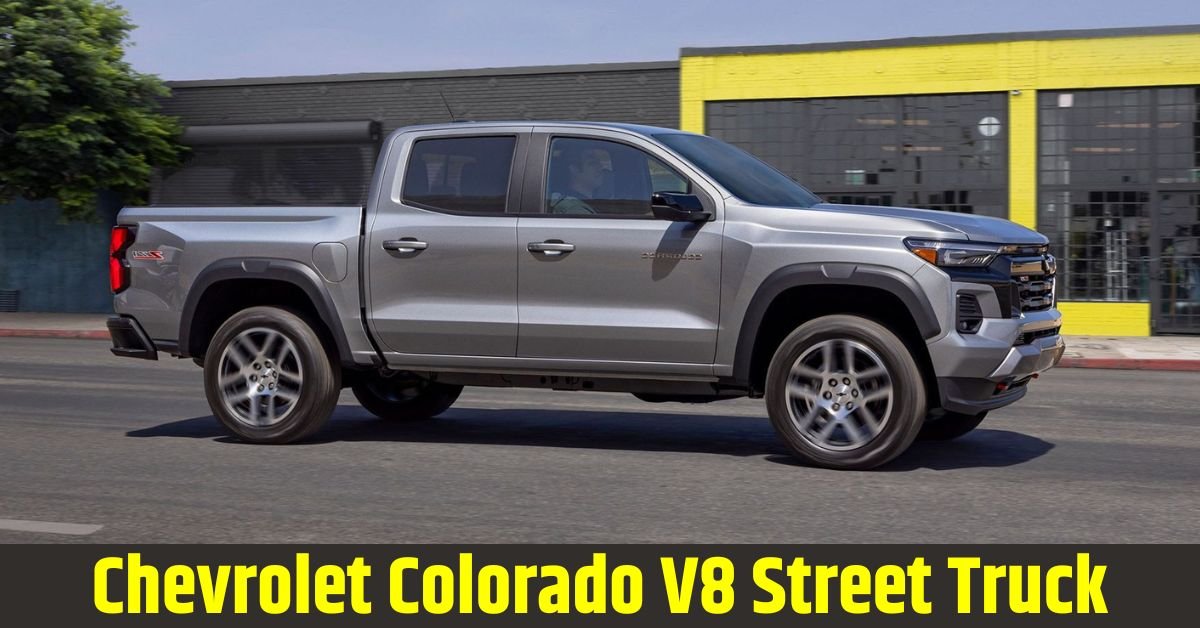

The Chevrolet Colorado was supposed to be the sensible little truck. Affordable, manageable, easy to park, and useful enough for people who didn’t need a full-size Silverado. Then Chevy did something wonderfully unhinged: it stuffed a 5.3-liter V8 into it. Not as a one-off SEMA prank. Not as a dealer hot-rod conversion. A real factory-built V8 Colorado. Small truck, big engine, zero apology.
The V8 Chevrolet Colorado Pickup
The first-generation Chevrolet Colorado arrived for the 2004 model year as the replacement for the long-running Chevy S-10. The S-10 had been a compact-truck staple for years, but by the early 2000s, General Motors wanted a fresher name and a more modern product.
That’s how the Colorado entered the picture. It was larger and more contemporary than the S-10, but still far smaller than a Silverado. It competed with trucks like the Ford Ranger, Toyota Tacoma, Nissan Frontier, and Dodge Dakota.
At launch, the Colorado was exactly what most buyers expected from a small GM pickup. It offered four- and five-cylinder engines, manual or automatic transmissions, rear-wheel drive or four-wheel drive, and basic work-truck practicality.
Then, in 2009, Chevrolet added the surprise option: a 5.3-liter V8.
For a midsize pickup, that was a big deal. Actually, scratch that. It was borderline absurd, in the best possible way.
Why Chevy Put a V8 in the Colorado
The Colorado shared engineering roots with the GMC Canyon and had platform connections to the Hummer H3. That Hummer connection is important because the H3 Alpha used a 5.3-liter V8, giving GM a pathway to fit the engine into a smaller truck architecture.
Once the packaging challenge had been solved for the Hummer, giving the Colorado the same V8 became possible.
The result was one of the most unusual factory trucks of its era. The V8 Colorado wasn’t heavily advertised, and it didn’t become a mainstream sales hit. But for people who knew what it was, it had serious appeal.
| Model | Engine | Output | Production Years |
|---|---|---|---|
| Chevrolet Colorado V8 | 5.3-liter V8 | Around 300 hp | 2009–2012 |
| Hummer H3 Alpha | 5.3-liter V8 | Around 300 hp | Late 2000s |
| GMC Canyon V8 | 5.3-liter V8 | Around 300 hp | 2009–2012 |
The V8 gave the Colorado the kind of low-end shove that its smaller engines simply couldn’t match. It also gave Chevy a quirky performance truck at a time when the midsize pickup market was starting to lose steam.
A Small Truck With Silverado Energy
The 5.3-liter V8 used in the Colorado produced about 300 horsepower and 320 lb-ft of torque. That may not sound wild by today’s standards, where even some turbocharged four-cylinders make big numbers, but in 2009, that was stout for a compact or midsize pickup.
The engine was paired with a four-speed automatic transmission. No fancy dual-clutch wizardry here. No ten-speed automatic. No hybrid assist. Just a V8, an automatic, and the kind of old-school GM simplicity that still makes these trucks interesting today.
The V8 Colorado could be ordered in extended-cab and crew-cab configurations, with rear-wheel drive or four-wheel drive depending on setup. It wasn’t a stripped-down muscle toy only offered in one configuration. It was a genuine factory option, tucked into the lineup almost casually.
And that’s what makes it so funny now. Chevy basically built a little sleeper truck and acted like it was no big deal.
Performance
The V8 Colorado was not a polished performance machine in the way a modern sport truck might be. It did not have the refinement of today’s high-output pickups. It did not have launch control, drive modes, or a luxury cabin wrapped around its powertrain.
But it had something better: surprise.
A small pickup with a 5.3-liter V8 under the hood is going to feel lively. The Colorado’s relatively compact size and lighter weight helped the engine feel stronger than it might in a larger truck. Acceleration was quick enough to make the V8 model feel genuinely different from the standard versions.
| Specification | Chevrolet Colorado V8 |
|---|---|
| Engine | 5.3-liter V8 |
| Horsepower | Around 300 hp |
| Torque | Around 320 lb-ft |
| Transmission | 4-speed automatic |
| Drivetrain | Rear-wheel drive or four-wheel drive |
| Estimated towing capacity | Up to around 6,000 lbs, depending on configuration |
It wasn’t just about speed, either. The V8 made the Colorado better for towing and hauling. Buyers who wanted midsize dimensions but more power than the regular engines could finally get both.
The Hummer H3 Connection
The Colorado V8 and Hummer H3 Alpha connection is one of the best parts of this story.
The Hummer H3 was never as massive as the H2, but it still carried the brand’s boxy, military-inspired attitude. When the H3 Alpha received the 5.3-liter V8, it became far more appealing to buyers who thought the standard five-cylinder felt underpowered.
Because the Colorado and H3 were related under the skin, the V8 migration made engineering sense. But from a market perspective, it was still odd. The H3 was an image vehicle. The Colorado was a practical small truck. Giving both the same V8 created a strange little family bond between a lifestyle SUV and a workaday pickup.
That’s why the V8 Colorado feels like something that slipped through a product-planning meeting while everyone was distracted.
Sales Were Limited, Which Makes It Interesting Today
The first-generation Colorado sold well when it first arrived, but demand faded as the decade went on. Midsize trucks were not the hot segment then that they are today. Many buyers either moved into full-size pickups or left small trucks behind entirely.
By 2010, Colorado sales had dropped sharply from the early years. The V8 version arrived during that decline, which means it never had a huge audience.
Commonly cited estimates suggest that fewer than 5,000 V8 Colorado examples were built over the production run. Exact counts can vary depending on how people separate Chevrolet Colorado and GMC Canyon production, but the overall point is clear: these trucks were rare.
| Factor | Why It Matters |
|---|---|
| Short production window | V8 option was only available late in the first generation |
| Low overall sales | Colorado demand had cooled by then |
| Minimal marketing | Many buyers didn’t even know the V8 existed |
| Niche appeal | Small-truck buyers were often focused on price and economy |
| Shared GMC version | Canyon V8 models were also built but remained uncommon |
Today, that rarity gives the V8 Colorado a cult following. It is not a mainstream collectible, but truck people know. And when truck people know, prices usually start getting interesting.
Why the V8 Colorado Feels Cooler Now Than It Did Then
At the time, the V8 Colorado was an oddball. Today, it feels almost rebellious.
Modern midsize trucks have become more refined, more expensive, and more tech-heavy. Many rely on turbocharged four-cylinder or V6 engines. Some are extremely capable, but very few have the simple charm of a naturally aspirated V8 in a small pickup body.
That simplicity is part of the appeal. The V8 Colorado came from a period when GM still had plenty of small-block V8 goodness to spread around. It didn’t need to shout. It didn’t wear wild graphics. It didn’t arrive with a dramatic performance badge. It just existed.
And that’s why enthusiasts like it.
It has sleeper energy. Park one next to a regular first-gen Colorado, and most people won’t notice anything unusual until they hear it start.
How It Compared With Rivals
The V8 Colorado was unusual because most rivals did not offer anything quite like it.
The Toyota Tacoma had strong resale value and off-road credibility, but no factory V8. The Ford Ranger of that era was aging and basic. The Nissan Frontier offered a V6, but not an eight-cylinder. The Dodge Dakota did offer V8 power, making it the closest rival in spirit, though the Dakota was generally larger and had a different personality.
| Truck | Available V8? | Character |
|---|---|---|
| Chevrolet Colorado | Yes | Rare, compact sleeper |
| GMC Canyon | Yes | Same formula with GMC badge |
| Dodge Dakota | Yes | Larger midsize V8 option |
| Toyota Tacoma | No | Durable, popular, strong resale |
| Ford Ranger | No | Older-school compact work truck |
| Nissan Frontier | No | V6-powered practical rival |
In hindsight, the Colorado V8 stands out because it came from a narrow moment when GM had the engine, the platform, and just enough willingness to do something weird.
Buying One Today
A used V8 Colorado can be tempting, but buyers should not treat it like an ordinary cheap old pickup. The engine itself has a strong reputation, but the truck is now old enough that condition matters more than mileage alone.
Rust, neglected maintenance, worn suspension parts, transmission condition, and previous owner modifications all deserve close attention. Some trucks may have been used hard, especially if buyers chose the V8 for towing or work use.
Clean, original examples are the ones enthusiasts tend to chase. Four-wheel-drive crew-cab trucks are especially desirable because they combine the V8 with the most practical body style.
| What to Check | Why It Matters |
|---|---|
| Frame and body rust | Older trucks can suffer in snow-belt states |
| Transmission behavior | The 4-speed automatic should shift cleanly |
| Cooling system | Important for towing and V8 reliability |
| Suspension wear | Payload and age can take a toll |
| Modifications | Poorly installed aftermarket parts can create issues |
| Service records | Maintenance history matters more as these trucks age |
The best example is not always the cheapest one. With a rare truck like this, paying more for a clean, unmodified example can make sense.
Final Thought
The V8 Chevrolet Colorado was one of GM’s stranger and cooler truck decisions from the late 2000s. It took a practical midsize pickup and gave it an engine that felt almost too big for the job. The result was a factory-built sleeper with Hummer DNA, Silverado attitude, and genuine rarity.
It was not perfect. The cabin was basic, the transmission was old-school, and the market barely noticed it when it was new. But today, that’s part of the charm.
In an era where trucks keep getting more complicated, the V8 Colorado feels refreshingly straightforward. Small truck. Big engine. That’s the whole pitch. And honestly, it still works.
FAQs
What years did Chevrolet sell the V8 Colorado?
Chevrolet offered the V8 Colorado from 2009 through the end of the first-generation model’s run.
What engine was in the V8 Chevy Colorado?
It used a 5.3-liter V8 producing around 300 horsepower and 320 lb-ft of torque.
Was the V8 Colorado related to the Hummer H3?
Yes. The Colorado shared platform connections with the Hummer H3, and the V8 option was closely tied to the H3 Alpha’s powertrain.